So, I looked into this whole robot-demo thing a bit more.
And I keep coming back to the same question: what is actually the intention behind all these videos?
You see a cheap robot arm, often from somewhere in Asia, a few 3D-printed parts, some motor or gripper that is hard to identify, a camera, a pretty wobbly table, a bunch of recorded episodes, and then a trained policy that finally does the task. Sometimes there is a 4090 or 5090 workstation somewhere in the setup. Sometimes people rent very expensive A100s just to train the policy.
I am not saying this is bad. Some of it is really impressive. Maybe the intention is simply to give something back to the community. Maybe it is research. Maybe it is about collecting data and selling it later to larger generalist models. I do not know.
But I also know that many people look at these videos and start thinking: maybe this could become a business.
And that is where I think we need to be very careful.
If you train a policy at home, that does not mean it works in a production environment. And even if it works technically, that still does not mean you are allowed to sell it as an industrial solution.
That is the part that gets skipped too often. The demo looks like the product. But it is not the product.
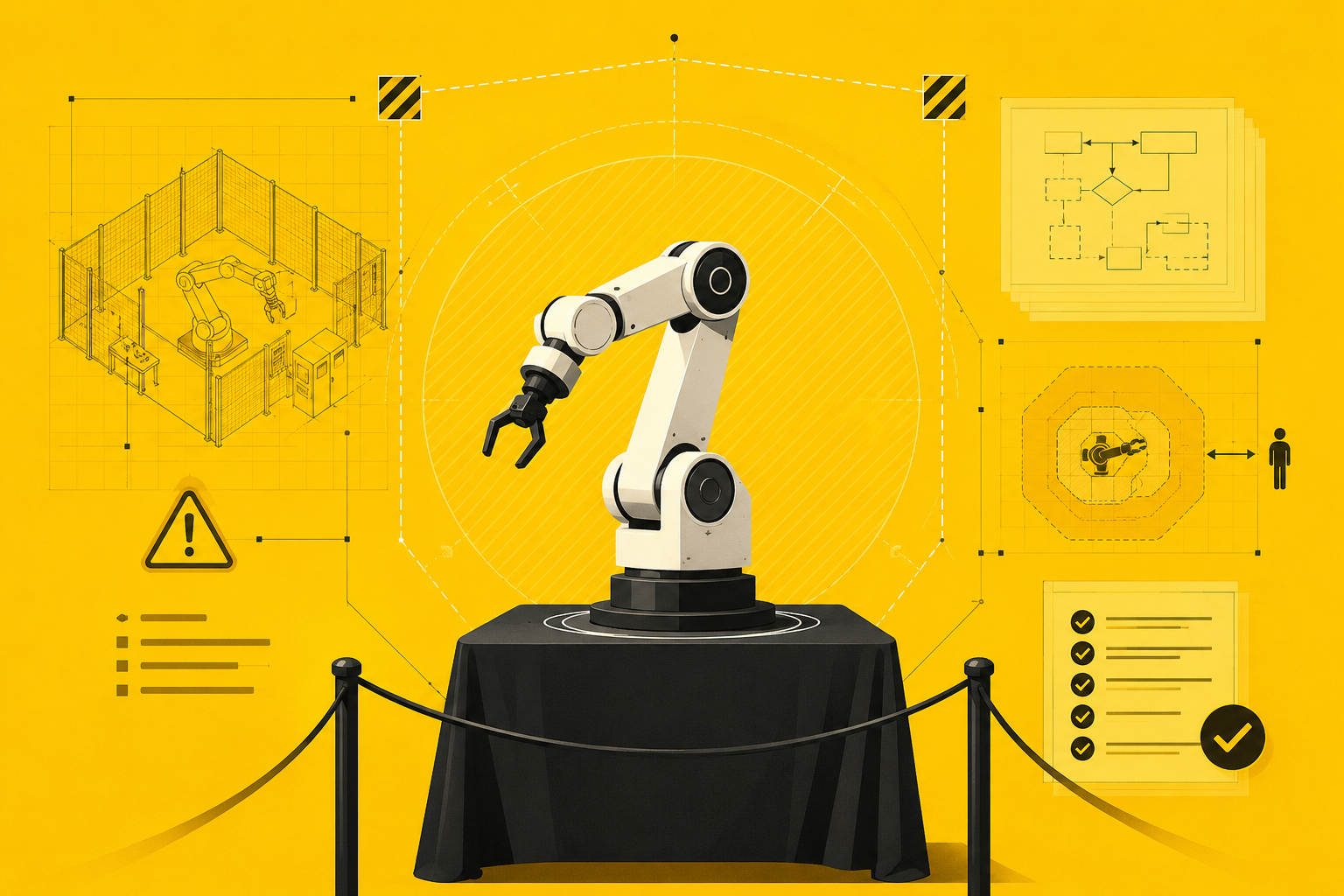
The video is not the product
A video can show that something is possible. It cannot show that something is safe, documented, validated, insurable, maintainable and ready for a real factory.
The moment you sell a robot arm, a table, a gripper, a camera, an edge box and an AI skill as one working cell, you are not just selling software anymore. You are selling a machine application. And then the boring words suddenly matter: risk assessment, safety architecture, CE, documentation, operating instructions, update control, validation, liability.
I know this sounds like paperwork. But it is not paperwork. It is the product.
Because in a real production environment the question is not only: can the robot do the task once? The question is: what happens when the camera drifts? What happens when the part is slightly different? What happens when the gripper half-holds something? What happens when the fixture moves? What happens when somebody reaches into the cell? What happens after a software update? What happens if the model is confident and wrong?
That is where the real work starts.
Europe is hard — but that can become a moat
I looked at this from the perspective of Europe, the United States and China. And my current view is this: Europe is probably the hardest place to do this properly at the beginning, but that is not only a disadvantage.
In Germany and the EU, if you bring a robotic cell to market, you very quickly enter the world of CE, technical files, risk assessment, declarations of conformity, operating manuals and product liability. It is a high upfront burden. No question.
As a startup, that hurts. You want to build. You want to test. You want to move fast. And then suddenly you have to think about documentation, safety concepts and the exact limits of your system.
But the other side is important: if you manage to build a hardware-AI product in Europe properly, you also build something that is much harder to copy. Not because CE itself is magic. It is not. But because the discipline behind it forces you to build evidence, not just demos.
And serious manufacturing companies care about that. They care about safety. They care about product liability. They care about whether something can be defended internally, legally and technically. They do not just want a robot that looks good in a thirty-second clip.
So yes, Europe creates friction. But if you survive that friction, it can become a market-entry barrier for others.
The US looks easier, but only at first glance
The United States is different. There is no CE system in the same European sense. So at first glance it looks easier.
But easier does not mean safe for the company selling the product. In the US you run into OSHA, ANSI/RIA, NFPA, UL or NRTL expectations, local electrical inspectors, insurance requirements, customer specifications and, most importantly, product liability.
That can become very expensive very quickly.
So I would not say: Europe is hard and America is easy. I would say: Europe is formal up front, America can be brutal later if you are careless.
If something happens in a customer factory, nobody will care that your demo once looked impressive. They will ask: who integrated the cell? Who defined the safety limits? Who validated the skill? Who approved the update? Who trained the operator? Who wrote the instructions? Who accepted the risk?
China is not where I would start
China is another topic again. You have certification uncertainty, local standards, possible CCC or CQC issues for components, Chinese documentation, data and cybersecurity requirements, IP risk and export-control issues, especially when US chips, AI infrastructure or advanced computing are involved.
Can you manufacture cheaper? Of course. Can you move faster in some areas? Probably. But cheap is not the same as trustworthy. And for a young company whose real advantage is skill logic, data, field experience, validation and deployment know-how, China is a very dangerous early market.
My view is simple: China later, maybe. But not as the first serious market. Not with the full system. Not with the full training pipeline. Not with raw field data leaving the customer site. Not without local legal and compliance support.
The builder lesson
For me, the lesson is not: stop building. Quite the opposite. Build, test, publish, show demos, collect data, learn from real failures. But do not confuse a demo with a deployable industrial product.
If you want to turn robot learning into a company, the hard part is not only the model. It is the system around it: setup, limits, validation, logs, data rights, updates, safety and liability. That is the part that decides whether a nice prototype can become something a factory would actually trust.
This is also where the claims matter. The dangerous claims are the easy ones: general robot brain, works everywhere, no setup, autonomous AI worker. Maybe they sound good in a pitch deck. But they create expectations the product probably cannot carry yet.
The more credible path is less flashy: narrow task, clear limits, real validation, field data, better recovery, and then expansion from there.
Price the hidden work
And this is my main point for anyone trying to turn robot demos into a company: do not price the demo. Price the real product.
The real product includes the safety work, the setup, the validation, the documentation, the support, the updates, the data governance, the liability exposure and the ability to say where the system must stop.
If this is not included in the business model, then the business model is not real yet. Not because the robot cannot move. The robot may move beautifully. But because the company has not understood what the customer actually buys.
This is not meant to discourage anyone building in Munich, Zurich, Boston, Shenzhen or anywhere else. Quite the opposite. Keep building. We need more people who actually build things instead of only talking about them.
But if the goal is real production, then do not confuse the video with the product.
The demo shows the exciting part.
The product is everything the demo hides.